See Beyond the Presenting Problem
Every client has a story beneath the symptoms.
Our free Attachment-Informed Formulation Toolkit will help you recognise the patterns beneath anxiety, emotional dysregulation, relationship difficulties and recurring therapeutic challenges—so you can formulate with greater confidence and respond more intentionally.
Practical. Reflective. Ready to use in your next client session.
See Beyond the Presenting Problem
Free Attachment-Informed Formulation Toolkit for Psychologists, Psychotherapists & Counsellors
Have you ever finished a session knowing there was something important happening beneath your client's presenting problem—but struggled to put it into words?
Many clients present with anxiety, depression, relationship difficulties or emotional dysregulation. Yet these symptoms are often expressions of deeper attachment patterns that shape how they relate, regulate emotions and experience the world.
This practical toolkit introduces an attachment-informed way of thinking that can help you:
Formulate with greater confidence
Recognise what behaviour may be communicating beneath the surface
Understand protective strategies through an attachment lens
Ask deeper formulation questions in your clinical work
Build greater therapeutic understanding and connection
From theory to clinical confidence
Whether you're new to attachment theory or looking to deepen your clinical thinking, this resource offers practical insights you can begin using immediately.

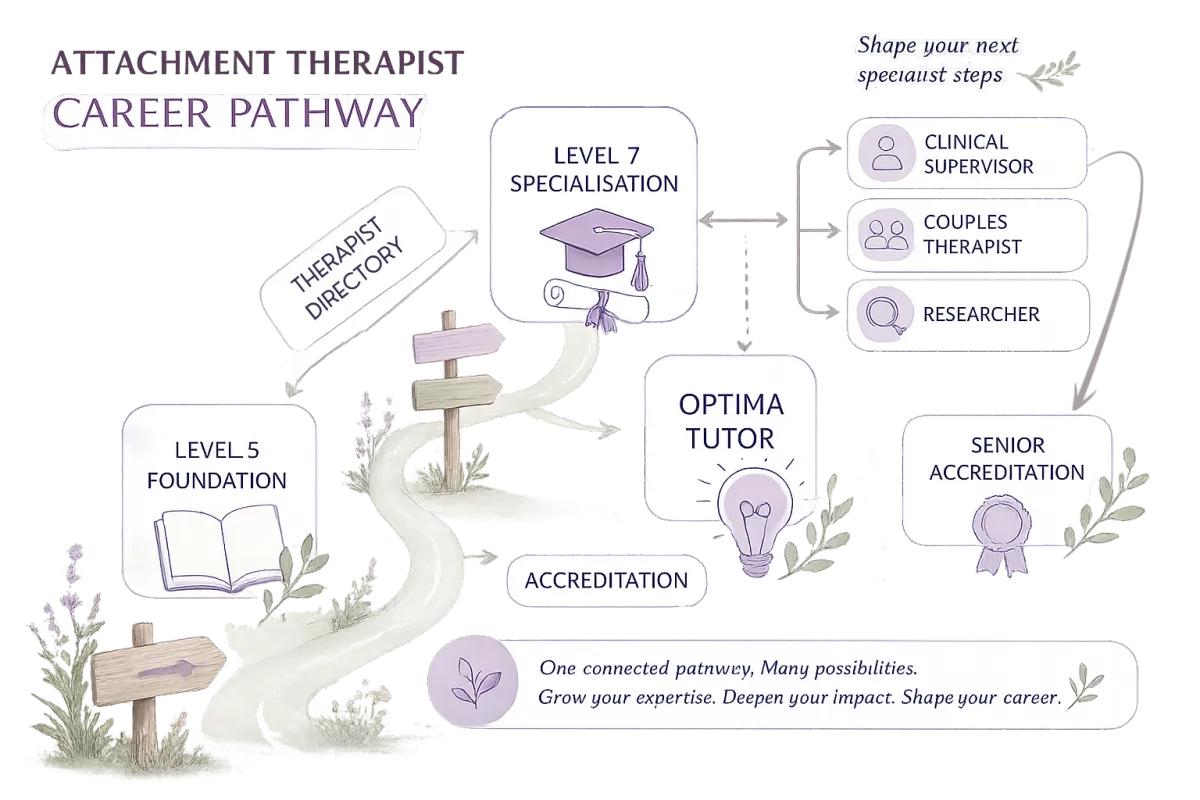
Want to learn more about Attachment - here are some Testimonials of our Diploma Training


Wendy Horton

I am currently studying a level 5 in Attachment Based Therapy with Optima. The course has consolidated all of my counselling training to date and given me a greater understanding of how relational patterns develop and how past experiences affect our current ones. I highly recommend this course to any therapist looking to gain experience in this field and incorporate into your practice.

Vickie Fox
I am currently studying the Level 5 attachment-based psychotherapy diploma and I am really enjoying it. The course is written in a way that builds knowledge of theory whilst showing how this intergrates into practice. The way I work with clients has changed, I am now able to offer a deeper more relational experience and the course has given me access to useful resources and tools to aid my practice. I recommend this course 100%.

Tracy Helps
The best training I have done in 20 years. The insights both personally and professionally have been more profound than I ever could of imagined.
FAQs
Answers to Your Questions About Optima Attachment Training
What is attachment theory?
Attachment theory, as formulated by John Bowlby, proposes that infants have biologically based attachment behaviours that lead them to seek and maintain proximity to a particular caregiver, especially when distressed, frightened, tired, or threatened; this closeness functions as protection and supports survival.
Bowlby described attachment figures as providing a secure base from which a child can explore, and he argued that repeated early experiences with caregivers contribute to the child’s developing working models of self and others.
Sources: Bowlby’s The Nature of the Child’s Tie to His Mother (1958), Attachment and Loss, Volume I: Attachment (1969/1982), and A Secure Base (1988).
Who can benefit from Optima Attachment Training courses
Our courses benefit therapists, counsellors, psychotherapists, psychologists and social workers interested in attachment theory. Either in the UK or Australia.
Are there any prerequisites for enrolling in the certification programs?
Level 5 applicants must have completed a level 4 or above diploma in attachment-based psychotherapy or its equivalent to enrol.
Level 7 applicants must have completed
- A level 4 and level 5 Diploma in attachment-based psychotherapy or its equivalent
- A minimum of 540 previous guided learning hours (GLH)
- Have over 450 post-qualification counselling hours (three years minimum post-qualification).
- Member of a professional body
- Minimum of 40 hours of personal therapy previously undertaken
- Have an understanding of Attachment Theory
How long does it take to complete a certification program?
Standard pathway courses run from September - June term time only.
Momentum pathway runs from January - July term time only.
Does Optima Attachment Training offer a payment plan
Yes, we offer an interest free payment plan over 10 months with a deposit payable to secure your place.
What type of teaching is used in Optima Attachment Trainings programs?
Our programs are delivered through 31 weeks of live training online. Planned feedback points built into the student journey. Repeat the self-assessment at key stages. Short tutor check-ins at specific points in the course. A held student space where delegates can discuss learning and reflect safely.
Contact Us
+61 45739045